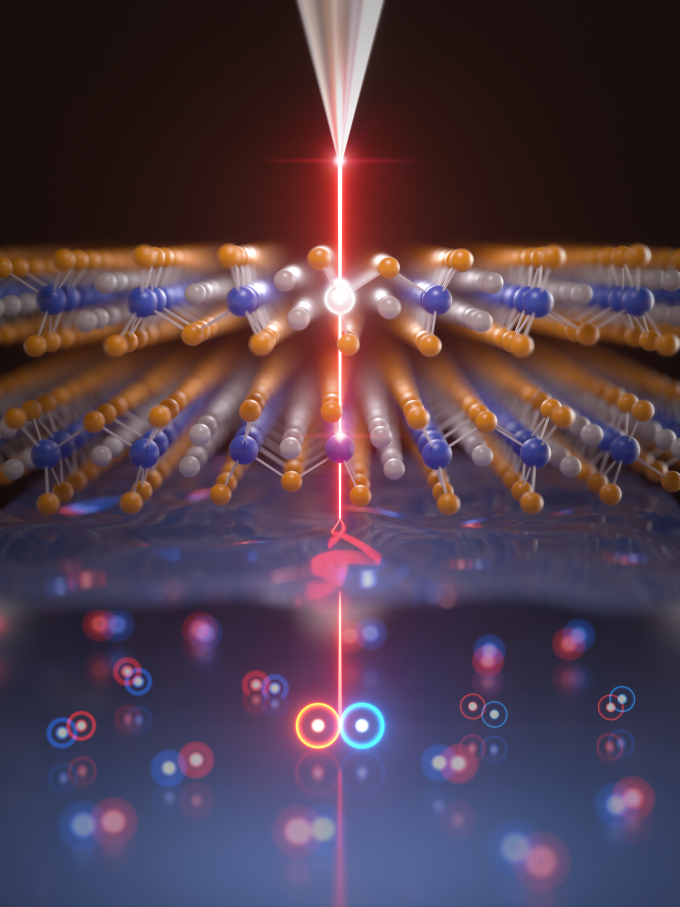
A technology to observe and control the quantum state known as an “exciton condensate” has been developed, paving the way for next-generation ultra-low-power devices.
The Institute for Basic Science (IBS) announced on the 3rd that the research team led by Han Woong Yeom, director of the Center for Quantum Nanoscience of van der Waals Materials (professor of physics at POSTECH), has for the first time observed a new electronic state inside an exciton condensate and succeeded in controlling it at the nanometer (nm, one-billionth of a meter) scale. The results were published on the 3rd in the international journal Nature Nanotechnology.
An exciton is a quasiparticle in which a negatively charged electron and a positively charged hole, created where an electron has left, coexist as a bound pair. A quasiparticle is not strictly a single particle, but a concept that treats the collective motion arising from the interactions of many particles as if it were one particle. Excitons act as an interface between electricity and light.
When formed excitons do not move independently but instead constitute a single, orderly quantum state, this phenomenon is called exciton condensation. Unlike conventional information transfer based on the motion of electrons, an exciton condensate transmits information in a superfluid state without resistance or friction. A superfluid is a state in which many particles condense into a single quantum state and flow collectively.
Cases in which an exciton condensate state is actually realized inside a solid are extremely rare. The team focused on the layered material tantalum palladium telluride (Ta2Pd3Te5), which has been reported to maintain an exciton condensate state even at room temperature.
Using a scanning tunneling microscope (STM), they analyzed how atomic defects inside the material affect the exciton condensate. As a result, they discovered that a pair of electronic states not previously observed emerges around specific atomic defects. While the size of the defect itself was on the scale of a single atom, the newly discovered electronic states extended over 5–6 nm.
By combining experiments with theoretical calculations, the researchers clarified that the observed state is not simply electrons trapped at a defect, but a new quantum state formed through the interaction between atomic defects and the exciton condensate. This is the first observation of the Yu–Shiba–Rusinov (YSR) state of an exciton condensate, which had previously existed only theoretically.
The team further confirmed that when a local strain is applied to the material and the exciton condensate state is weakened, the defect electronic states disappear together. When they locally modified the charge using the STM tip, both the exciton condensate state and the defect electronic states changed in tandem. In doing so, they succeeded in precisely controlling the exciton condensate state at the scale of a few nanometers.
First author Seongjin Kwon, postdoctoral researcher at the IBS Center for Quantum Nanoscience of van der Waals Materials, explained, “This achievement is significant in that we have directly identified defect-related quantum states in an exciton condensate that had so far only been predicted theoretically.”
Director Yeom stated, “We expect that by further advancing the technology for precise control of exciton condensate states, we will lay the groundwork for developing future ultra-low-power devices.”
 Center for Artificial Low